RTT Therapy and Coaching: Why the Combination Creates Lasting Change
People often ask whether they need RTT therapy or coaching (be it Mindset & Performance Coaching or Holistic Health Cocaching). The real answer is that they do very different jobs, and when combined, they can be incredibly powerful.
Many people try coaching first. They set goals, track habits, build routines and add accountability. Sometimes it works. Often, it feels harder than it should. You know what to do, but something inside you resists. You procrastinate, self-sabotage, or fall back into old patterns.
That is usually the moment people realise there is something deeper at play.
This article explains the difference between Rapid Transformational Therapy (RTT) and coaching, and why using them together often leads to faster, more sustainable change.
Two approaches, one single goal
The simplest way to understand the difference is this:
RTT looks backward.
Coaching looks forward.
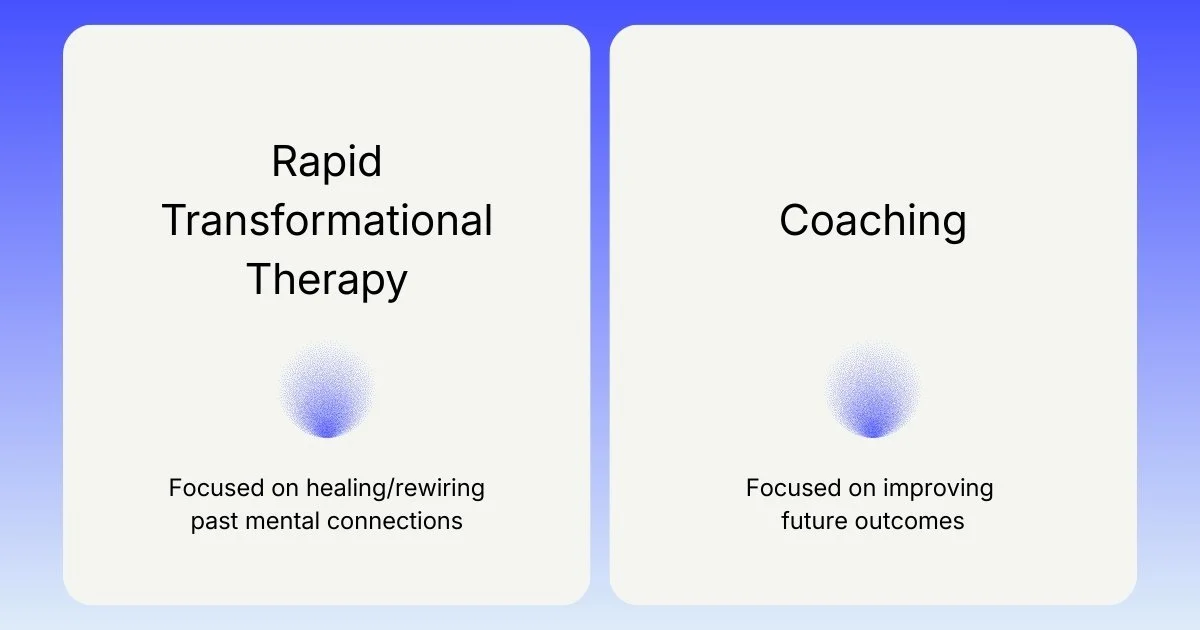
Both are valuable. They just work on different layers of the mind.
RTT focuses on the past. Not to dwell on it, but to understand how certain beliefs, emotional reactions and habits were formed.
Coaching focuses on the future. It helps you decide who you want to become and how to live differently on a daily basis.
When people only work on the future without addressing the past, progress can feel like pushing a heavy boulder uphill. When people only work on the past without building new habits, insight does not always translate into real-life change.
What RTT actually works on
RTT is designed to identify and remove unhelpful subconscious associations.
Many behaviours that feel irrational today made perfect sense at some point in the past. The subconscious mind learns through repetition and emotional intensity. Once it links something with comfort, safety, relief or belonging, it keeps repeating that pattern.
For example:
Chocolate becomes linked with comfort after stressful days
Procrastination becomes a way to avoid pressure or fear of failure
Overworking becomes tied to self-worth or feeling valued
RTT works by going back to where these associations were created and helping the mind update them. Once the association is removed, the behaviour often changes naturally. You are no longer fighting yourself.
This is why RTT can make adopting new habits feel easier. You are not relying on discipline to override desire. The desire itself has shifted.
What coaching actually works on
Coaching is future-focused and practical. It is about implementation, consistency and direction.
Coaching helps you:
Clarify goals and priorities
Design supportive daily habits and rituals
Stay accountable to what matters to you
Build self-trust through follow-through
Coaching is extremely effective when the path is clear and the inner resistance is low. It turns insight into action. It helps you integrate change into real life, especially in busy, demanding environments.
However, coaching becomes much harder when there is an unresolved subconscious block underneath. In those cases, accountability alone can feel exhausting.
Bringing it to life: The Chocolate Example

Imagine someone wants to stop eating chocolate every evening.
With coaching alone, they might set rules. No chocolate at home. Accountability check-ins. Habit tracking. It can work, but it often feels like effort. The craving is still there. The desire has not changed. The person is simply resisting it.
Now imagine that same person works with RTT and removes the subconscious association between chocolate and emotional comfort. Chocolate is no longer linked to relaxation or safety.
After that, coaching becomes much easier. There is far less resistance. The habit changes not because of pressure, but because the behaviour no longer serves a purpose.
This is the difference between pushing through change and allowing change.
Why RTT and coaching together are so effective
RTT clears the ground. Coaching builds the structure.
RTT helps remove outdated beliefs like:
I need this to cope
This is how I relax
I cannot change this part of myself
Coaching then helps install new ways of living:
New routines
New emotional regulation tools
New identity-level habits
When combined, people often report that change feels more natural, faster and more sustainable. They are not fighting old programming while trying to build a new life.
Signs you might benefit from RTT first
Many people reading this will recognise themselves here. You might benefit from RTT if:
You know what to do but cannot seem to do it
You feel emotionally triggered around specific behaviours
You repeat patterns that do not align with your goals
You feel frustrated with yourself despite high self-awareness
These are often signs that something subconscious needs updating.
Signs coaching would support you as well
Even after RTT, change still needs to be lived.
Coaching is especially helpful if you want:
Structure and consistency
Support with building new habits
Guidance during life transitions
Accountability that feels supportive rather than pressuring
Coaching helps turn internal shifts into visible, lasting results.
A more complete approach to change
Lasting change rarely comes from willpower alone. It comes from alignment between the subconscious mind and conscious goals.
RTT helps you release what no longer serves you. Coaching helps you step into who you want to become.
When both are used together, people often stop asking why change feels so hard. It simply starts to feel more possible.
If you recognise yourself in this article, there is a good chance that there is something ready to be released and something new ready to be built. You do not have to choose between therapy and coaching. In many cases, the combination is what creates real transformation.