The Real Reason for Low Self Confidence and How It Starts
Many high performers describe their lack of confidence as a personal flaw. They think they simply need to toughen up or try harder. Yet low self confidence is not weakness. It is a learned response that once kept you safe.
When you understand that, self-criticism turns into clarity. Because if lack of confidence was learned in response to danger, it can also be unlearned once safety returns.

What Low Self Confidence Really Is
Adaptation mistaken for identity
What most people call insecurity is rarely part of their nature. It is an adaptation the mind built to manage risk. When being visible once led to criticism or rejection, the nervous system concluded that it is safer to hold back. Over time, this becomes identity: I am shy. I am not confident.
The body remembers safety rules
Confidence does not live in logic. It lives in the body. If the body still associates attention with threat, no amount of positive thinking will change behaviour. Real change begins when the body experiences safety in situations that once felt unsafe.
How the Mind Learns to Stay Small
The role of belonging and approval
Humans are biologically designed to seek belonging because our ancestors survived by depending on the group. For most of human history, people lived in small cooperative bands where cooperation, shared resources, and protection from predators were essential for survival.
Social connection allowed early humans to hunt together, share food, and care for children. These benefits are so significant that our brains evolved to prioritise social bonds as deeply as physical needs like food and safety.
Feeling excluded or rejected activates warning signals in the nervous system similar to physical threat, motivating us to restore connection.
This need to belong begins in childhood when attachment relationships to parents and early friends shape how safety feels. A child learns quickly what earns acceptance and what risks connection, because feelings of closeness or exclusion influence regulation of emotion and future expectations of safety. If assertiveness once reduced intimacy, the mind may store a simple rule: staying quiet keeps me safe.
This is well documente, as you can read in The Evolution of Social Connection as a Basic Human Need by Stephen Braren, Ph. D.A real example: Anouk’s story
Anouk from Paris (name changed) came to us with chronic low self confidence. As a founder, she dreaded networking events and believed she simply needed to be braver.
Through RTT Therapy, we uncovered something different. In childhood she often heard her parents say be quiet whenever she became enthusiastic. Her young mind made a clear link: being quiet keeps me loved.
As an adult, that link still operated below awareness. Visibility felt unsafe because being seen once led to disapproval. During her RTT sessions we worked to separate safety from silence. Once that association released, expression stopped feeling like risk.
Within weeks she was attending events comfortably. During follow-on Mindset & Performance Coaching, she shared that she had already built two new partnerships. Her confidence returned not because she forced herself to be louder but because she finally felt safe to be seen.
“I can’t believe it. I’m finally able to attend networking events without being terrified. And I landed two new partnership deals!”
How childhood shapes subconscious safety rules
Many adults carry similar rules without realising it. Environments that reward politeness, modesty, or compliance teach that restraint equals worth. Others grow up around perfectionism or unpredictability and learn to monitor every move. Each rule begins as protection and stays long after it is needed.
You might recognise patterns such as:
Being told to “use your inside voice” whenever excitement or laughter became too loud.
Hearing that “good girls don’t make a fuss” or that “nice boys don’t talk back.”
Watching a parent withdraw affection or approval when you disagreed or asked for more attention.
Seeing conflict arise whenever someone in the family spoke honestly or challenged authority.
Learning that emotional expression was labelled dramatic, attention-seeking, or rude.
Noticing that praise arrived when you were quiet, helpful, or agreeable, and criticism arrived when you showed initiative or individuality.
Each moment sends the same quiet message: love is safer when I am small.
Over time, that belief becomes woven into identity, shaping how safe it feels to be seen and heard.
The Inner Conflict Between Desire and Safety
Wanting visibility but fearing exposure
By adulthood, two forces often collide. One part of you wants to speak, lead, and expand. Another part quietly applies the brakes. The result is hesitation, overthinking, or physical tension before moments of visibility.
Why logic cannot override protection
You can tell yourself you are safe, yet if the nervous system remembers danger, it will not agree. The mind protects first and reasons later. This is why advice such as “just be confident” rarely works. Until safety is restored, the protective response wins.
How this tension drains focus
Living in this push-pull costs energy. You prepare for opportunities yet withdraw at the last moment. You appear calm yet feel depleted. Confidence cannot grow in a body caught between progress and protection.
When Protection Becomes Limitation
Recognising outdated safety patterns
The same patterns that once protected you eventually restrict you. You might notice that you:
• Dismiss compliments quickly
• Stay silent when you have something valuable to add
• Feel invisible even when you want to connect
These are not failures. They show your system is ready for change.
Awareness softens self-judgment
Seeing hesitation as protection changes how you relate to it. Instead of forcing yourself to push through, you begin to listen. That curiosity reduces tension and opens the door to change.
Releasing the internal fight
Most people try to build confidence through force. They aim to silence fear rather than understand it. True progress happens when both parts of you—the part that wants to grow and the part that guards safety—begin to cooperate.
Relearning Safety to Rebuild Self Confidence
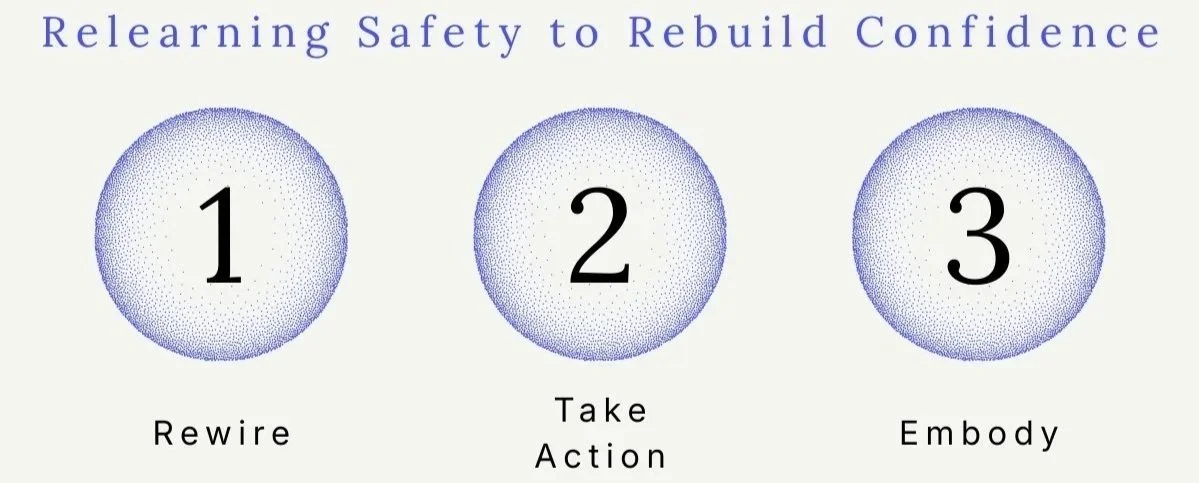
Re-wiring your subconscious mind
For patterns rooted in early experience, conscious effort alone is slow. Subconscious work such as RTT Therapy helps identify and release the original safety rules. Follow-on Mindset & Performance Coaching then anchors new behaviours in daily life. The aim is freedom, not volume.
If this resonates, you can explore how RTT and Coaching help rebuild confidence from safety, not pressure.
The body leads the way
Once the mind is re-wired, it’s time to take action. Confidence returns through experience, not instruction. Each time you express yourself and remain safe, your body updates its data. Safety becomes familiar again, and confidence follows naturally.
From performance to embodiment
At first, new confidence feels like performance. Over time, it becomes quiet certainty. This shift marks the difference between acting confident and being safe enough to express who you are.
A Final Reflection
Low self confidence is not a personal defect. It is a signal that safety once depended on staying small.
When you stop blaming yourself and start understanding the purpose behind that pattern, something shifts. The effort to prove yourself softens. Expression feels lighter.
Confidence grows naturally when it is no longer competing with fear.